

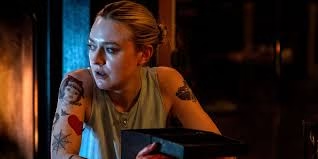

Bryan Bertino’s psychological horror film Vicious, starring Dakota Fanning, dropped on Paramount+ on October 10, 2025, leaving audiences with a haunting finale that demands unpacking. This isn’t your typical horror movie with clear-cut answers—instead, it delivers a deeply metaphorical exploration of trauma, self-destruction, and the impossible games we play with our own minds.
Vicious Premise: A Deadly Game with Changing Rules
The film centers on Polly (Dakota Fanning), a woman grappling with personal struggles when a mysterious elderly woman with an amputated finger appears at her door. The stranger leaves behind a cryptic wooden box containing an hourglass, delivering a chilling ultimatum: Polly will die tonight unless she places three specific items inside the box before time runs out.
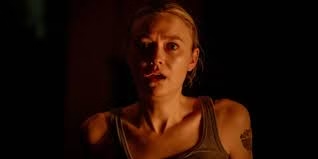
The Rules:
- Something she needs
- Something she hates
- Something she loves
What follows is a nightmarish descent as Polly faces psychological torment, distorted reality, and violent manifestations of her deepest fears.
Breaking Down the Ending
| Key Element | Explanation | Significance |
|---|---|---|
| The Box’s True Nature | Personalized psychological weapon targeting emotional wounds | Adapts to each victim’s specific trauma |
| Polly’s Survival Method | Refused to play the game; let the timer expire | Victory through surrender, not combat |
| Physical Consequences | Lost finger and toe | Permanent reminder of psychological battle |
| The Transfer | Box moves to neighbor with new instructions | Cycle continues with fresh victim |
| Changed Rules | Neighbor must give “something you want” | Confirms personalized torment for each player |
The Box: A Self-Loathing Engine
The mysterious box isn’t a supernatural entity seeking random victims—it’s a precision instrument of psychological destruction. The film reveals that the box specifically targets “broken people,” exploiting their deepest emotional wounds surrounding grief, neglect, and self-hatred.
Here’s the brilliant twist: The box’s demands change for every victim. While Polly faced the triad of “need, hate, love,” her neighbor receives different instructions centered on “something you want.” This adaptation proves the box functions as a personalized torture device, custom-tailored to each person’s unique vulnerabilities and failings.
Director Bryan Bertino himself confirmed the story serves as a metaphor for toxic relationships where rules constantly shift, keeping victims perpetually off-balance and unable to win.
How Polly Survived
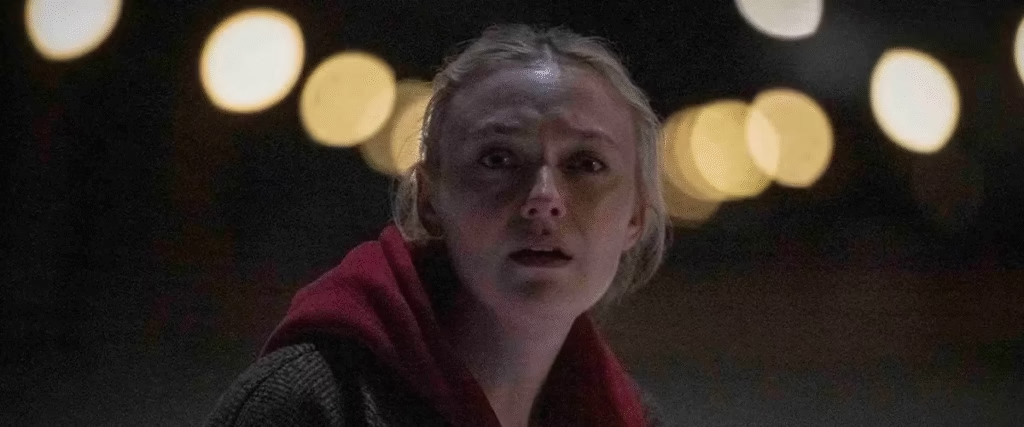
Unlike traditional horror protagonists who defeat the monster, Polly survives through exhausted surrender. After enduring reality distortions, self-harm impulses, and threats to her family, she makes a radical choice: she stops playing the game.
By allowing the hourglass to run out and accepting her perceived demise, Polly breaks the psychological cycle. She refuses to engage with the trauma pattern the box feeds on. When she wakes up scarred but alive—minus a finger and toe—her survival represents something profound: freedom through acceptance rather than control.
The final symbolic moment comes when Polly ignores a ringing phone, representing her rejection of the torment’s attempt to pull her back into the game. This conscious choice signals genuine recovery.
For more insights into psychological horror narratives, explore our horror movie analysis collection at TechnoSports.
The Universal Horror: The Cycle Continues
The film’s most chilling revelation comes in its closing moments. As Polly escapes the box’s grip, it immediately transfers to her neighbor, beginning the cycle anew with personalized torment. This suggests the box represents something larger than a single supernatural threat—it’s a manifestation of universal human suffering, always seeking vulnerable targets.
The horror isn’t defeated because it can’t be defeated through conventional means. It’s a cyclical poison representing the self-destructive patterns we all face, waiting for moments of weakness to strike.
The Deeper Meaning
Vicious transcends typical horror by using supernatural elements as metaphors for real psychological struggles:
Self-Loathing as Monster: The box doesn’t create fear—it amplifies existing self-hatred and trauma already present in its victims.
Impossible Standards: The constantly changing rules mirror how trauma and toxic relationships keep moving goalposts, making “victory” impossible.
Escape Through Acceptance: Polly’s survival teaches that some battles are won by walking away, not fighting harder.
According to Paramount+’s official horror collection, Vicious joins a growing trend of elevated horror films exploring psychological depth over jump scares.
Discover more streaming recommendations and movie analyses at TechnoSports, your source for entertainment guides.
Frequently Asked Questions
Q: How does Polly survive the box in Vicious?
Polly survives by refusing to play the box’s game and letting the hourglass timer expire instead of trying to fulfill its demands. By accepting her fate and breaking the psychological cycle through surrender rather than compliance, she escapes with her life—though scarred with the loss of a finger and toe as permanent reminders.
Q: What does the mysterious box represent in Vicious (2025)?
The box represents a personalized psychological weapon that targets broken individuals, functioning as a metaphor for self-loathing, trauma, and toxic relationship patterns. It adapts its demands to each victim’s specific emotional vulnerabilities, creating impossible scenarios that feed on grief and self-destructive impulses rather than seeking physical items.

