

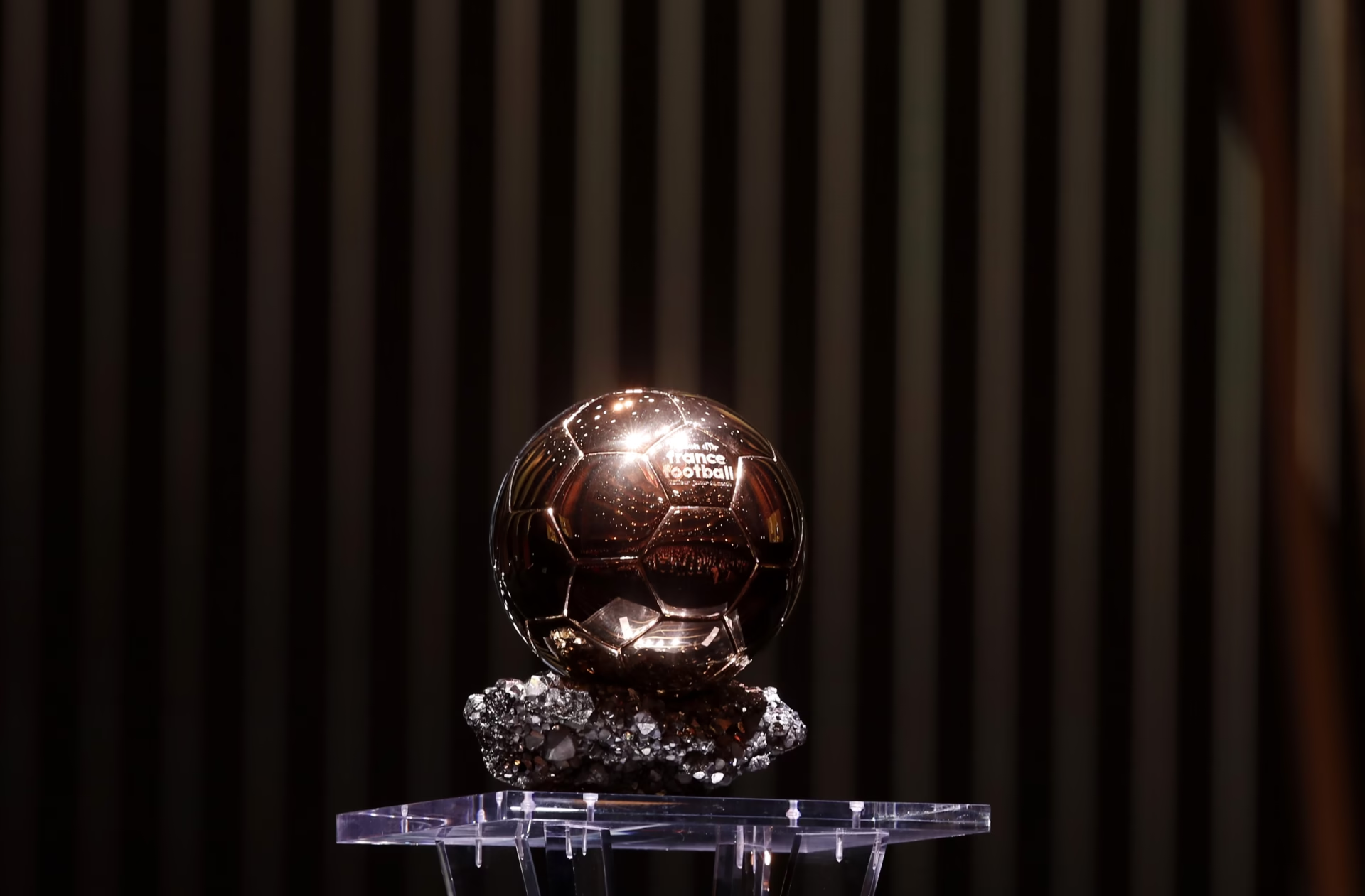

Winning football’s most prestigious individual accolade once represents the pinnacle of a player’s career. Winning it three consecutive times elevates an athlete into rarefied air reserved for only the sport’s absolute legends. Since the Ballon d’Or’s inception in 1956, just three players have achieved this extraordinary feat of dominance, cementing their legacies as generational talents who transcended their eras.
The Ballon d’Or Legacy: Football’s Ultimate Individual Prize
| Award Details | Information |
|---|---|
| First Awarded | 1956 |
| Inaugural Winner | Stanley Matthews (England) |
| Most Wins Overall | Lionel Messi (8 titles) |
| Most Nominations | Cristiano Ronaldo (18 times) |
| Most Consecutive Wins | 4 (Lionel Messi, 2009-2012) |
| Voting Panel | International journalists from top 100 FIFA-ranked nations |
| Women’s Award Started | 2018 (Ballon d’Or Féminin) |
The Ballon d’Or, translated as “Golden Ball” in English, stands as football’s most coveted individual distinction. Originally restricted to European players performing for European clubs, the award expanded in 1995 to include all players at European clubs regardless of nationality, then became truly global in 2007 when eligibility extended to players worldwide. Between 2010 and 2015, it merged with FIFA’s World Player of the Year to create the FIFA Ballon d’Or before reverting to its original format.
Top 3 Players to Win Three Consecutive Ballon d’Ors
1. Michel Platini: The Pioneer of Consecutive Dominance (1983-1985)
The French maestro blazed the trail as the first player in Ballon d’Or history to claim three consecutive golden trophies. Michel Platini’s remarkable run from 1983 to 1985 coincided with his peak years at Juventus, where he established himself as one of Europe’s most feared attacking midfielders.
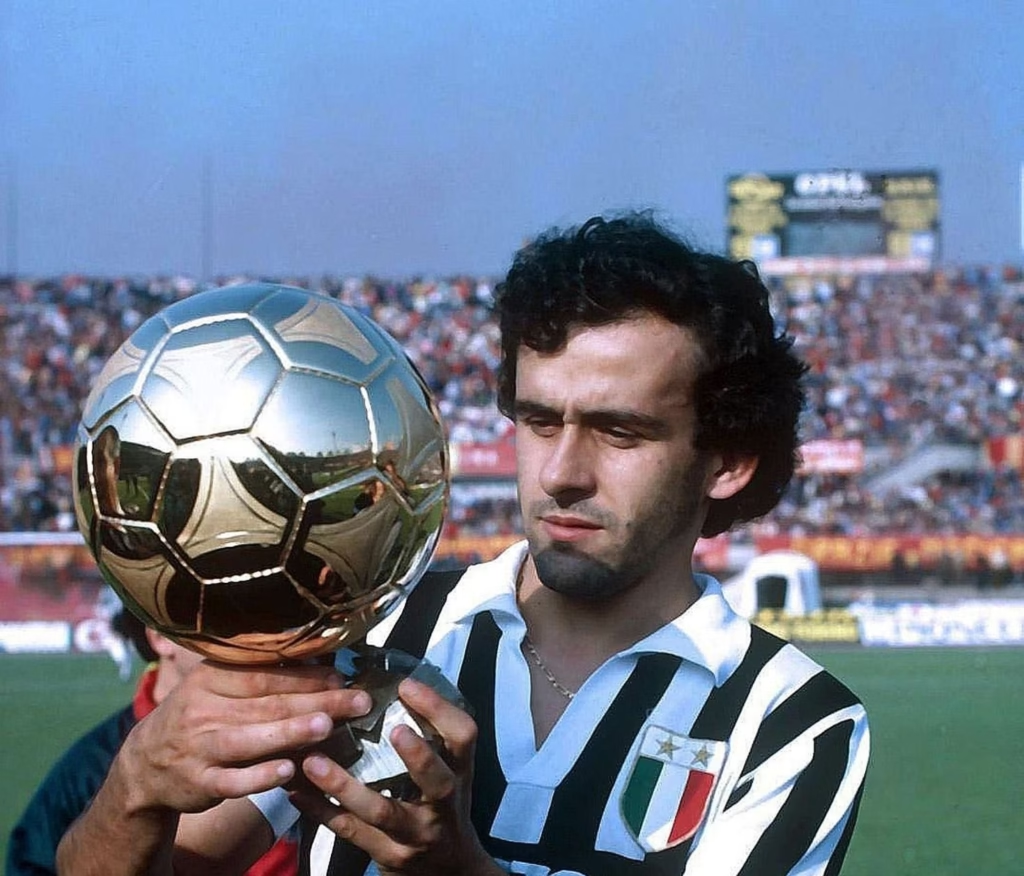
Platini’s Three-Year Reign
| Year | Club | Key Achievement | Competition |
|---|---|---|---|
| 1983 | Juventus | Reached European Cup Final | Serie A Capocannoniere |
| 1984 | Juventus | Led France to EURO glory with 9 goals | European Cup Winners’ Cup champion |
| 1985 | Juventus | European Cup winner | Third consecutive Serie A top scorer |
1983: The Foundation
Platini secured his maiden Ballon d’Or after an exceptional season that saw Juventus reach the European Cup final. His creative brilliance and goalscoring prowess from midfield revolutionized the attacking midfielder role, earning him the first of three consecutive Serie A top scorer awards—a remarkable achievement for someone not playing as an out-and-out striker.
1984: International Glory
The Frenchman’s second consecutive Ballon d’Or came on the back of a sensational UEFA European Championship performance. Platini’s record-breaking nine goals at Euro 1984 remain unmatched in tournament history. He orchestrated France’s dominant march to their first major international title, scoring in virtually every match including the dramatic semi-final against Portugal and the final against Spain. His free-kick goal in the final, aided by a costly error from Spanish goalkeeper Luis Arconada, secured France’s 2-0 victory and cemented his legendary status.
1985: European Peak
Platini completed his hat-trick of Ballon d’Or awards after leading Juventus to European Cup glory, though the triumph was tragically overshadowed by the Heysel Stadium disaster. His third consecutive Serie A top scorer title demonstrated sustained excellence rarely witnessed in football history. Nicknamed “Le Roi” (The King) for his imperious ability and leadership, Platini finished his career with three Ballon d’Ors, a total only later matched by two other legends.
Platini’s Statistical Dominance
During his three-year reign, Platini dominated Italian football while excelling internationally. His ability to score prolifically from midfield redefined expectations for creative players, inspiring future generations of playmakers to contribute more directly to goalscoring. His vision, free-kick expertise, and tactical intelligence made him virtually unstoppable during this golden period.
2. Lionel Messi: Four Consecutive Triumphs Rewrite History (2009-2012)
If Platini pioneered three consecutive Ballon d’Or victories, Lionel Messi obliterated the record by extending the streak to an unprecedented four successive awards. The Argentine’s dominance between 2009 and 2012 represented perhaps the most remarkable individual period in football history, characterized by statistical achievements that bordered on the absurd.
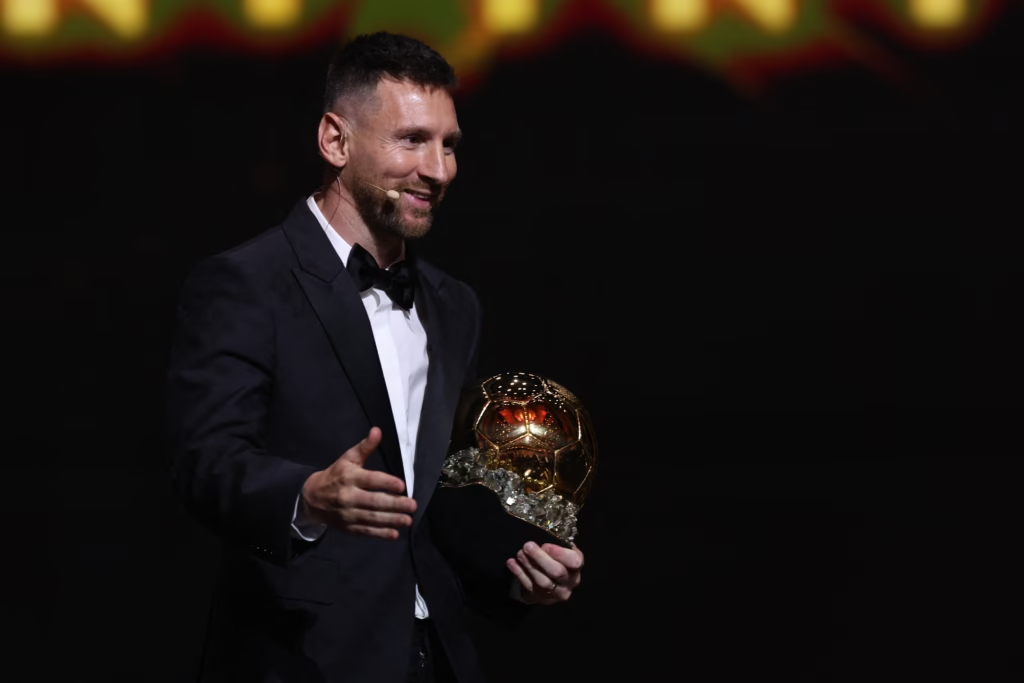
Messi’s Historic Four-Year Streak
| Year | Goals (Calendar Year) | Major Trophies | Historic Achievement |
|---|---|---|---|
| 2009 | 47 | Barcelona Treble | First of eventual 8 Ballon d’Ors |
| 2010 | 60 | La Liga, Supercopa | Record 53 club goals in single season |
| 2011 | 59 | Champions League, La Liga | Third player with 3 Ballon d’Ors |
| 2012 | 91 | La Liga, Copa del Rey | Broke Gerd Müller’s 40-year record |
2009: The Emergence
At just 22 years old, Messi captured his first Ballon d’Or after orchestrating Barcelona’s historic treble under Pep Guardiola. The Catalans claimed La Liga, Copa del Rey, and the Champions League in 2008-09, with Messi’s 38 goals across all competitions proving instrumental. Barcelona extended their success by adding the Spanish Super Cup, UEFA Super Cup, and FIFA Club World Cup before year’s end, establishing the foundation for sustained dominance.
2010: Breaking Barriers
Messi’s second consecutive Ballon d’Or came after another sensational year that saw him score 60 goals for club and country—a total previously deemed unimaginable. His 53 goals in all competitions for Barcelona during the 2009-10 season established a new club record. The Argentine beat Barcelona teammates Xavi and Andrés Iniesta to the award, highlighting the Catalans’ collective excellence while recognizing Messi’s individual supremacy.
2011: Team Glory Meets Individual Brilliance
The third consecutive Ballon d’Or arrived after Messi’s most complete season. Barcelona won La Liga, Champions League, UEFA Super Cup, Spanish Super Cup, and Club World Cup in 2011—missing only the Copa del Rey from their trophy cabinet. Messi became just the fourth player to win three Ballon d’Ors overall, joining the exclusive company of Johan Cruyff, Michel Platini, and Marco van Basten. His 53 goals across all competitions, including crucial Champions League performances, made him the obvious choice.
2012: Shattering Records
Messi’s fourth consecutive Ballon d’Or—unprecedented in the award’s history—followed a year of almost supernatural productivity. His 91 goals scored for Barcelona and Argentina in the 2012 calendar year demolished Gerd Müller’s legendary record of 85 goals set in 1972. The achievement seemed beyond human capability, yet Messi made it appear routine. Despite Barcelona winning fewer major trophies in 2012, Messi’s individual dominance proved so overwhelming that he claimed the award with a record margin.
The Messi Phenomenon
This four-year stretch represented the apex of Messi’s powers. Playing primarily as a false nine under Guardiola, he combined the creativity of a playmaker with the finishing of an elite striker. His dribbling ability, vision, and goalscoring consistency during this period remain unparalleled. The Argentine would go on to win four additional Ballon d’Ors (2015, 2019, 2021, 2023), bringing his total to a record eight—a mark that may never be surpassed.
Between 2008 and 2023, Messi and his great rival Cristiano Ronaldo won 13 of 15 Ballon d’Ors, establishing a duopoly over football’s highest individual honor. However, only Messi achieved three or more consecutive victories during this era of sustained excellence.
3. Aitana Bonmatí: Modern Excellence in Women’s Football (2023-2025)
The third member of this exclusive club brings the Ballon d’Or consecutive victories discussion into the modern era and women’s football. Spanish midfielder Aitana Bonmatí recently completed her hat-trick of consecutive Ballon d’Or Féminin awards, establishing herself as the dominant force in women’s football.

Bonmatí’s Three-Year Reign
| Year | Club | Key Achievement |
|---|---|---|
| 2023 | Barcelona | World Cup winner with Spain |
| 2024 | Barcelona | Champions League and Liga F dominance |
| 2025 | Barcelona | Third consecutive Ballon d’Or Féminin |
Breaking New Ground
Since the Ballon d’Or Féminin’s introduction in 2018, it has honored exceptional female talent previously overlooked by football’s award structure. Norway’s Ada Hegerberg became the inaugural winner, but Bonmatí’s consecutive triumphs from 2023 to 2025 elevated her into historic company.
The Barcelona midfielder’s technical excellence, tactical intelligence, and leadership qualities have made her the central figure in one of women’s football’s most successful teams. Her ability to control matches from midfield while contributing goals and assists mirrors the complete midfield mastery displayed by legends like Platini during his peak years.
World Cup Triumph
Bonmatí’s first Ballon d’Or Féminin in 2023 came after she played a pivotal role in Spain’s Women’s World Cup victory. Her performances throughout the tournament showcased her ability to dictate tempo, create chances, and score crucial goals. The World Cup triumph, combined with continued domestic and European success with Barcelona, made her the obvious choice for the award.
Sustained Excellence
Unlike one-season wonders, Bonmatí maintained and arguably improved her level in subsequent years. Her second and third consecutive awards in 2024 and 2025 demonstrated remarkable consistency and the ability to perform under the increased scrutiny that comes with being recognized as the world’s best player. Her achievements have inspired a new generation of female footballers and brought greater attention to the women’s game.
Other Notable Ballon d’Or Achievers
While only three players have won three consecutive times, several legends have claimed the award multiple times across their careers:
| Player | Total Wins | Years Won |
|---|---|---|
| Lionel Messi | 8 | 2009, 2010, 2011, 2012, 2015, 2019, 2021, 2023 |
| Cristiano Ronaldo | 5 | 2008, 2013, 2014, 2016, 2017 |
| Johan Cruyff | 3 | 1971, 1973, 1974 |
| Marco van Basten | 3 | 1988, 1989, 1992 |
| Michel Platini | 3 | 1983, 1984, 1985 |
Johan Cruyff and Marco van Basten each won the award three times but never consecutively. Cruyff’s victories came in 1971, 1973, and 1974, while Van Basten triumphed in 1988, 1989, and 1992. Cristiano Ronaldo won back-to-back awards in 2013-2014 and 2016-2017 but never achieved three straight victories.
The Evolution of Voting Criteria
The Ballon d’Or voting system has evolved significantly since 1956. Originally, only European-based journalists voted exclusively for European players. The gradual expansion of eligibility and voting rights reflected football’s globalization. Between 2010 and 2015, national team coaches and captains joined journalists in the voting process during the FIFA Ballon d’Or era.
Since 2022, France Football modified the criteria once again. Awards now recognize achievements during a football season (August to July) rather than a calendar year. The voting panel consists of specialized journalists from countries ranked in the top 100 of FIFA’s rankings, with one representative per nation.
These changes aim to ensure the award reflects genuine merit rather than reputation or popularity, though debates about voting fairness persist. Critics occasionally describe it as a “popularity contest” and note potential bias toward attacking players over defensive stalwarts.
Legacy and Future Prospects
The three players who achieved three consecutive Ballon d’Or victories—Platini, Messi, and Bonmatí—share certain characteristics: exceptional technical ability, sustained peak performance across multiple seasons, playing for dominant teams, and the capacity to deliver in crucial moments.
As football continues evolving, the question remains: Who will next join this exclusive club? Current stars like Erling Haaland, Kylian Mbappé, and Vinícius Júnior possess the talent, but replicating the sustained dominance required for three consecutive victories represents an enormous challenge.
In women’s football, Bonmatí’s ongoing excellence suggests she could extend her consecutive victories even further, while emerging talents like Spain’s Salma Paralluelo and Barcelona teammate Caroline Graham Hansen could eventually mount their own challenges.
The Ballon d’Or’s history demonstrates that true greatness requires more than talent—it demands consistency, resilience, and the ability to maintain peak performance when the world expects nothing less. The three players who achieved consecutive triumphs understood this truth and delivered performances that defined their eras.
Read More: India Snatch Dramatic Draw as Rahim Ali’s Last-Gasp Strike Stuns Singapore
FAQs
Has any player won the Ballon d’Or four consecutive times?
Yes, Lionel Messi holds the record for most consecutive Ballon d’Or wins with four straight victories from 2009 to 2012. He remains the only player to achieve this feat, surpassing Michel Platini’s previous record of three consecutive wins.
Who was the first player to win three consecutive Ballon d’Ors?
Michel Platini of France became the first player to win three consecutive Ballon d’Or awards, claiming the trophy in 1983, 1984, and 1985 during his peak years at Juventus.
How many players have won the Ballon d’Or three times total?
Five players have won the Ballon d’Or three or more times: Lionel Messi (8), Cristiano Ronaldo (5), Johan Cruyff (3), Michel Platini (3), and Marco van Basten (3). However, only Platini and Messi won three consecutive times among male players.
When did the women’s Ballon d’Or start?
The Ballon d’Or Féminin was first awarded in 2018, with Norway’s Ada Hegerberg as the inaugural winner. Aitana Bonmatí became the first woman to win three consecutive awards (2023-2025).
What criteria determine the Ballon d’Or winner?
The Ballon d’Or is awarded based on individual performance, decisive and impressive character, team success during the season, and fair play. Specialized journalists from the top 100 FIFA-ranked countries each vote for their top choices using a points-based system.

