

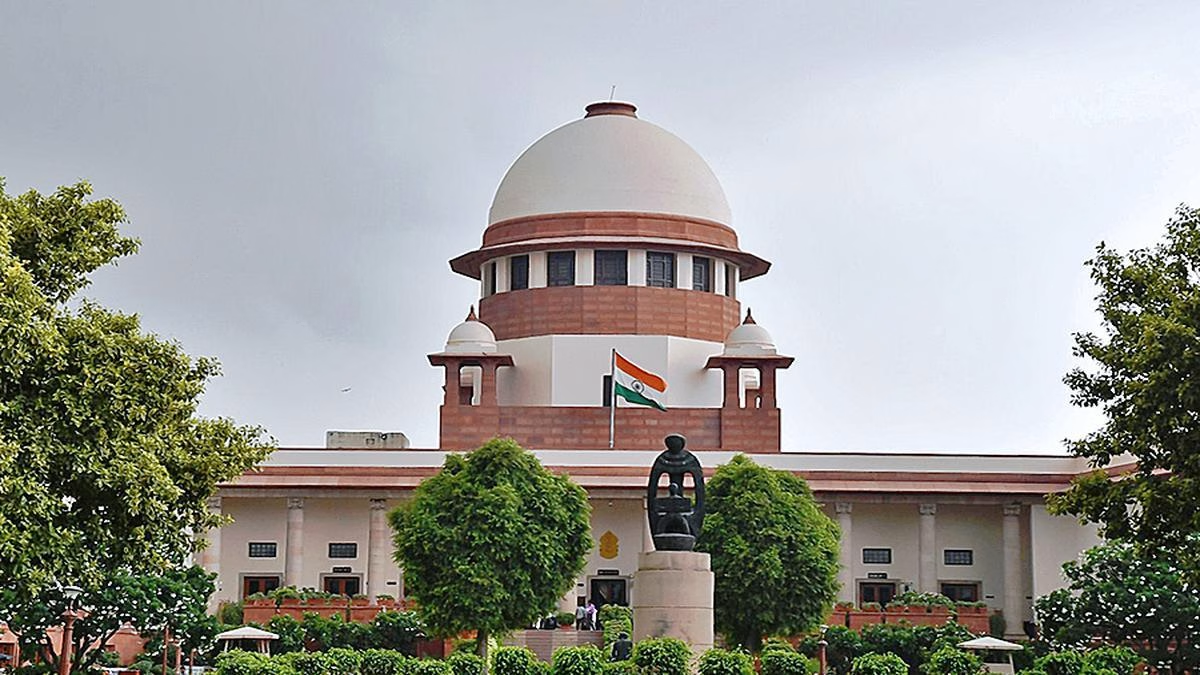

The All India Football Federation (AIFF) finds itself at the center of a constitutional crisis that threatens to derail Indian football’s most crucial season. With the Supreme Court scheduling the next hearing for August 22, 2025, stakeholders across the football ecosystem are grappling with unprecedented uncertainty that could affect over 5,000 livelihoods.
The Supreme Court Takes Center Stage
On Monday, August 18, 2025, the AIFF constitutional matter reached the Supreme Court through Amici Curiae Gopal Sankaranarayanan and Samar Bansal, appearing before Justices P.S. Narasimha and Atul Chandurkar. The timing couldn’t be more critical, with the Indian Super League (ISL) season hanging in the balance.
Justice Narasimha revealed that the court’s judgment is in its final stages of writing, but the recently passed National Sports Governance Bill has introduced new complexities that require careful consideration. The court has made it clear that all parties’ perspectives on this landmark legislation must be heard before any final decision.
Players Pay the Price: The Human Cost of Legal Battles
Behind the legal complexities lies a harsh reality affecting real people. Players across multiple clubs haven’t received their salaries for over a month, while coaching staff and support personnel face mounting uncertainty about their futures. The ripple effects extend far beyond the pitch, touching families and communities dependent on Indian football.
The situation has become so severe that FIFPRO, the global players’ union, has written to FIFA describing the circumstances as “alarming.” Their intervention highlights the international attention this crisis has garnered, potentially damaging Indian football’s reputation on the world stage.
The Master Rights Agreement: A Ticking Time Bomb
Central to the crisis is the Master Rights Agreement (MRA) between AIFF and Football Sports Development Limited (FSDL), which expires on December 8, 2025. This agreement governs the ISL, and its mid-season expiration creates an impossible situation for commercial partners.
Impact on ISL Season Structure
| Typical ISL Timeline | Current Crisis Impact |
|---|---|
| Season runs September-April | MRA expires December 8, mid-season |
| Sponsors commit for full season | Cannot secure season-long commitments |
| Broadcast rights locked early | Rights uncertainty affects coverage |
| Club preparations begin July | Pre-seasons stalled indefinitely |
The timing makes it practically impossible for FSDL to secure season-long sponsorships and broadcast deals when their operating rights vanish halfway through the campaign. This commercial uncertainty has frozen all league preparations.
AIFF’s Controversial U-Turn
Perhaps the most damaging development has been AIFF’s sudden reversal on approaching the Supreme Court. After President Kalyan Chaubey publicly assured ISL clubs that the federation would mention the matter on August 18, AIFF backtracked just hours before the hearing.
This last-minute change has shattered whatever trust remained between AIFF and the clubs. Sources close to the development expressed their frustration, questioning how stakeholders can rely on AIFF’s commitments when written assurances can be abandoned overnight.
Timeline of Events
- August 15: AIFF sends formal letter to clubs promising court mention
- August 17: Email confirmation sent to all parties
- August 17 (9 PM): AIFF informs stakeholders it won’t raise the issue
- August 18: Amici Curiae mention the matter independently
The National Sports Bill Factor
The National Sports Governance Bill 2025, recently passed by both houses of Parliament, has emerged as a game-changer in this legal battle. AIFF cited this legislation as the reason for their strategic retreat, arguing that alignment with new governance norms required careful consideration.
The Supreme Court acknowledged examining this bill while drafting the new AIFF constitution, demonstrating how legislative changes can impact ongoing judicial proceedings. This intersection of parliamentary legislation and judicial oversight creates additional complexity for all parties involved.
What Happens Next?
The August 22 hearing at 2:00 PM will be crucial for determining Indian football’s immediate future. Justice Narasimha has assured that the court will pronounce its decision before December 8, 2025, but stakeholders are pushing for greater urgency.
All parties must submit written submissions before the hearing, with AIFF promising to highlight the urgent need for commercial continuity and league structure clarity. FSDL, represented by Senior Advocate Ritin Rai, will finally get their opportunity to present their position after being unable to speak during the August 18 proceedings.
The Broader Impact on Indian Football
This crisis extends far beyond legal technicalities. The uncertainty has:
- Stalled player transfers and new signings
- Frozen commercial negotiations for the upcoming season
- Damaged Indian football’s reputation internationally
- Created financial hardship for players and staff
- Threatened the ecosystem supporting over 5,000 jobs
Looking Ahead: Critical Questions
As the August 22 hearing approaches, several critical questions demand answers:
- Will the court provide interim relief to ensure player payments?
- How will the National Sports Bill specifically impact AIFF’s governance?
- Can a new MRA be negotiated before December 8?
- What safeguards will protect players and staff during this transition?
The resolution of these issues will determine not just the fate of the upcoming ISL season, but the long-term trajectory of professional football in India. With international eyes watching and thousands of livelihoods hanging in the balance, the Supreme Court’s decision could reshape Indian football’s future.
As stakeholders prepare for what may be the most consequential hearing in Indian football history, the sport’s community can only hope that justice will be swift and comprehensive enough to save not just the upcoming season, but the broader ecosystem that has taken years to build.
Also read- Why a SIP Calculator is Essential Before Investing in Small Cap Mutual Funds

