



Kathryn Bigelow’s return to filmmaking after an eight-year hiatus delivers exactly what you’d expect from the Oscar-winning director: meticulous attention to detail, procedural authenticity, and an unflinching examination of American power structures under extreme pressure. “A House of Dynamite,” her latest political thriller now streaming on Netflix, transforms the apocalyptic nightmare of nuclear warfare into a bureaucratic exercise that’s both fascinating and frustrating in equal measure.

The film’s central premise is deceptively simple yet terrifyingly plausible: an unattributed intercontinental ballistic missile is detected heading toward Chicago with just 18 minutes until impact. What follows is not the explosive action spectacle that the title might suggest, but rather a methodical exploration of how America’s defense apparatus responds to the unthinkable.
The Structural Innovation Behind DEFCON-1 Drama
Bigelow and screenwriter Noah Oppenheim employ a bold narrative gambit that distinguishes “A House of Dynamite” from conventional disaster films. The story unfolds in three distinct acts, each replaying the same 18-minute crisis from different perspectives within the government hierarchy. This structural approach allows viewers to witness the same catastrophic event through multiple lenses, from ground-level military personnel to the highest echelons of political power.
Act-by-Act Breakdown
| Act | Primary Focus | Key Characters | Location |
|---|---|---|---|
| Act 1 | Frontline Defense | Major Gonzalez (Anthony Ramos), Captain Walker (Rebecca Ferguson) | Fort Greely, Alaska & White House Situation Room |
| Act 2 | Cabinet Response | Secretary Baker (Jared Harris), Deputy Baerington (Gabriel Basso) | Pentagon & NSC Offices |
| Act 3 | Presidential Authority | President (Idris Elba), General Brady (Tracy Letts) | Air Force One & STRATCOM |
This repetitive structure serves both narrative and thematic purposes. As Bigelow has noted, the repeated dialogue takes on a “mantra-like quality,” emphasizing how governmental responses can become mechanized even in the face of unprecedented crisis. The approach also highlights how information filters through bureaucratic layers, often losing crucial nuance along the way.
Kathryn Bigelow’s Directorial Mastery Under Pressure
Following her acclaimed trilogy of “The Hurt Locker,” “Zero Dark Thirty,” and “Detroit,” Bigelow continues her exploration of American institutions under extreme stress. However, “A House of Dynamite” represents a departure from her previous work’s kinetic energy. Instead of the visceral, ground-level perspective that defined her earlier films, this thriller operates primarily within fluorescent-lit control rooms and sterile government facilities.
Technical Excellence in Service of Realism
The film’s technical craftsmanship reflects Bigelow’s commitment to authenticity. Working with frequent collaborators including cinematographer Barry Ackroyd and editor Kirk Baxter, she creates an environment where the mundane mechanics of government feel both completely believable and unnervingly fragile.
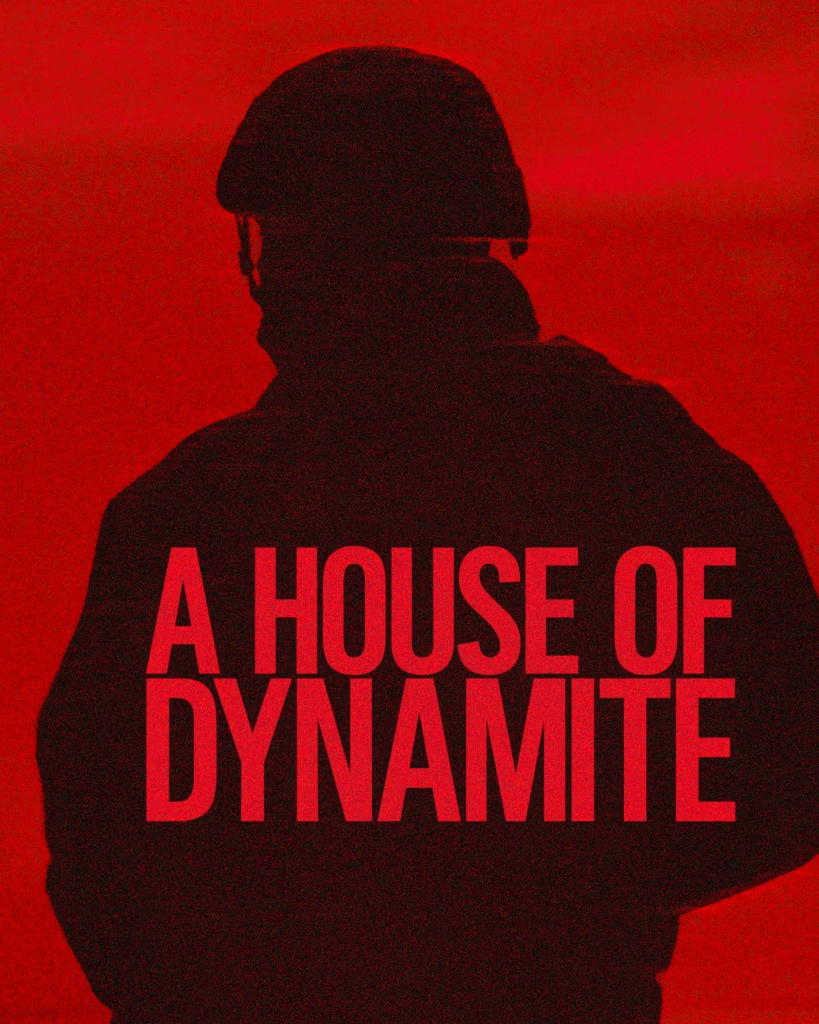
The production benefited from extensive consultation with actual military and intelligence professionals. Rebecca Ferguson, who plays Situation Room director Captain Olivia Walker, worked directly with Larry Pfeiffer, a 32-year veteran of the intelligence community and former senior director of the real White House Situation Room. This attention to procedural accuracy gives the film an documentary-like authenticity that makes its speculative scenario feel uncomfortably plausible.
Performance Analysis: Excellence Amid Institutional Chaos
The ensemble cast delivers uniformly strong performances, though the film’s structure limits individual character development in favor of institutional portraiture.
Standout Performances
Rebecca Ferguson anchors the film as Captain Walker, bringing steely professionalism to a role that requires her to maintain composure while coordinating a response to potential nuclear annihilation. Ferguson’s performance captures the character’s expertise while revealing the human cost of maintaining such professional detachment.
Idris Elba as the President faces the impossible task of making retaliatory decisions with incomplete information and devastating consequences. His portrayal emphasizes the isolation and overwhelming responsibility of executive power during crisis.
Tracy Letts delivers a commanding performance as General Brady, embodying the military perspective with his characteristic intensity. His memorable line—”This is not insanity. It’s reality”—encapsulates the film’s central thesis about the normalized presence of catastrophic threat in contemporary geopolitics.
Supporting Cast Excellence
| Actor | Role | Performance Highlight |
|---|---|---|
| Gabriel Basso | Deputy National Security Advisor | Conveys bureaucratic pressure and information overload |
| Jared Harris | Secretary of Defense | Balances professional duty with personal stakes |
| Anthony Ramos | Major Gonzalez | Represents frontline military perspective |
| Moses Ingram | FEMA Official | Highlights civilian emergency response challenges |
Critical Reception and Audience Response
“A House of Dynamite” has generated decidedly mixed critical reception, with responses largely divided along expectations for the thriller genre versus appreciation for procedural realism.
Positive Critical Perspectives
Glenn Kenny of RogerEbert.com awarded the film four stars, praising it as a “tense, precise, extremely sobering thriller” that showcases the range of its ensemble cast. Critics who praised the film highlighted its commitment to realism and its unflinching examination of governmental fallibility during crisis.
Pete Hammond of Deadline Hollywood noted that while the film “might not fall into the horror movie genre, it might as well because it is more frightening than any of them,” emphasizing how the realistic portrayal of nuclear crisis creates genuine dread.
Critical Concerns
However, several prominent critics found the film’s approach ultimately unsatisfying. The Ringer’s review noted that while the institutional atmosphere is convincingly rendered, the film’s thesis—that military-industrial complex personnel are “just regular people like you and me”—feels both familiar and facile.

Rolling Stone’s review criticized the film for promising character development that never materializes, arguing that viewers never become sufficiently invested in the ensemble to feel genuine emotional stakes during the crisis.
Audience Metrics
| Platform | Rating | Notable Comments |
|---|---|---|
| IMDb | 7.0/10 | Mixed responses; praised for realism, criticized for pacing |
| Metacritic | 75/100 | Generally favorable professional reviews |
| Netflix | Viewing data pending | Strong initial streaming numbers reported |
Thematic Depth: Nuclear Anxiety in the Modern Era
“A House of Dynamite” succeeds most effectively as a meditation on contemporary nuclear anxiety. Bigelow has noted that she “grew up at a time when we were asked to hide under our desks in the event of a nuclear blast,” and the film reflects both the persistence and evolution of these fears.
Contemporary Relevance
The film’s timing feels particularly prescient given current geopolitical tensions. The scenario of an unattributed nuclear attack reflects modern concerns about state and non-state actors with access to nuclear technology. Unlike Cold War-era nuclear films that focused on superpower conflict, “A House of Dynamite” explores the complexity of response when the attacker’s identity remains unknown.
Institutional Critique
Beyond its surface-level thriller elements, the film functions as a critique of American institutional responses to crisis. Bigelow presents a government apparatus that, despite extensive preparation and training, struggles with the human reality of making decisions with civilizational consequences.
Technical Craftsmanship and Production Values
The film’s production design effectively creates the claustrophobic atmosphere of government crisis management. Jeremy Hindle’s production design transforms various government facilities into believable spaces where world-altering decisions unfold amid mundane office environments.
Visual Strategy
Barry Ackroyd’s cinematography maintains the documentary-style realism that has become a Bigelow trademark. The camera work emphasizes the sterile, institutional nature of the spaces while creating intimacy during moments of personal crisis.

Kirk Baxter’s editing creates a relentless pace that mirrors the countdown structure, though some critics noted that the repetitive approach occasionally undermines narrative momentum rather than enhancing it.
Netflix Release Strategy and Industry Impact
“A House of Dynamite” received a limited theatrical release before its Netflix premiere, a strategy that reflects the challenging market for adult-oriented thrillers. The film’s streaming release allows it to reach audiences who might have missed its brief theatrical run.
Awards Consideration
The film premiered at the Venice International Film Festival, where it was nominated for the Golden Lion, indicating significant industry respect for Bigelow’s work despite mixed critical reception.
Final Verdict: Procedural Excellence vs. Entertainment Value
“A House of Dynamite” succeeds admirably as a procedural examination of governmental crisis response while struggling to deliver the emotional engagement typical of effective thrillers. Bigelow’s commitment to authenticity creates a convincing portrayal of how nuclear crisis might unfold, but this realism comes at the cost of traditional narrative satisfaction.
The film works best as a sobering reminder of institutional fragility and human fallibility in the face of existential threat. For viewers seeking explosive action or clear resolution, the film may disappoint. However, those interested in Bigelow’s continued exploration of American power structures will find much to appreciate in this methodical, unsettling examination of nuclear nightmare.

As a return to filmmaking for one of America’s most important political filmmakers, “A House of Dynamite” demonstrates both Bigelow’s continued relevance and the challenges of creating compelling cinema from procedural realism. The film may not explode with the force its title suggests, but it delivers a slow-burn examination of contemporary nuclear anxiety that lingers uncomfortably long after the credits roll.
FAQs
What is the basic plot of “A House of Dynamite” movie and how does the review assess it?
The film follows an 18-minute crisis as the U.S. government responds to an unattributed nuclear missile heading toward Chicago. The review notes that Kathryn Bigelow prioritizes procedural realism over explosive action, creating a methodical examination of institutional response to nuclear threat.
How does Kathryn Bigelow’s direction in this film compare to her previous work?
Unlike the kinetic, ground-level energy of “The Hurt Locker” and “Zero Dark Thirty,” Bigelow takes a more clinical approach, focusing on bureaucratic responses within government facilities rather than visceral action sequences, marking a notable evolution in her directorial style.
What makes the film’s structure unique according to the review?
The movie employs a three-act structure that replays the same 18-minute crisis from different governmental perspectives, allowing viewers to see how the same catastrophic event unfolds across various levels of the American defense hierarchy.
How have critics and audiences responded to “A House of Dynamite”?
The film has received mixed reviews, with critics praising its realism and procedural authenticity while criticizing its lack of emotional engagement. It holds a 7.0 IMDb rating and 75 Metacritic score, indicating generally favorable but divided reception.
What are the main strengths and weaknesses identified in this movie review?
The review highlights the film’s technical excellence, authentic portrayal of government crisis response, and strong ensemble performances as strengths, while noting its prioritization of procedural realism over traditional thriller entertainment and limited character development as potential weaknesses.

